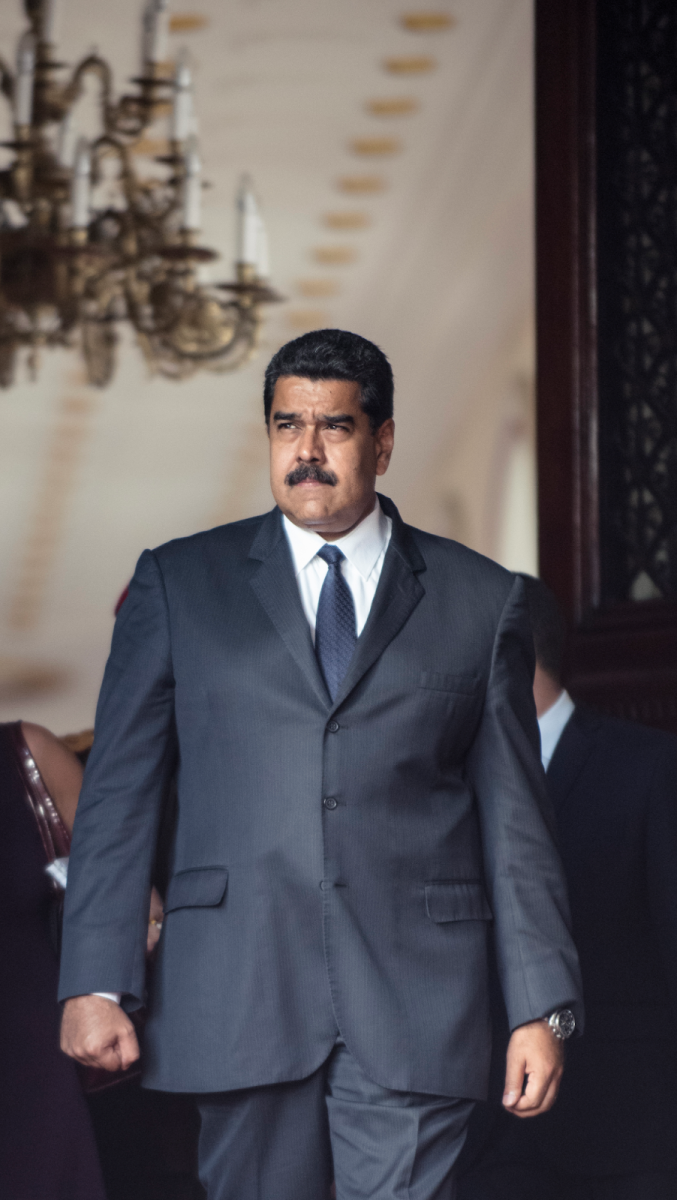
With a $50 million bounty on his head, former Venezuelan President Nicolás Maduro, his wife Cillia Flores, and his son were taken into US custody along with the Tren de Aragua gang leader, nicknamed “Niño Guerrero”, and the current and former Interior Minister. They were arrested in Caracas, Venezuela’s capital, on January 3 by US military forces. Maduro now faces several charges, including narco-terrorism conspiracy, drug trafficking, and conspiracy to possess and possession of machine guns and destructive devices. There has been much legal debate on whether President Donald Trump had the authority to order out-of-country arrests, with some claiming he had no authority due to the fact that Venezuela had not attacked the US first. However, the U.S. Department of Justice released a legal memo in support of the president’s decision to order overseas arrests and use troops to protect federal functions, citing in the memo ‘Re: Proposed War Department Operation to Support Law Enforcement Efforts in Venezuela’ published in December 2025 that stated “In determining whether the President may unilaterally order any use of military force in another country –- including the one at issue here –- we examine (1) whether the President can reasonably determine that the action serves important national interests, and (2) whether the “anticipated nature, scope and duration” of the conflict falls within the President’s constitutional authority…” Sophomore Christian Reynoso-Spurrier expressed support and, when interviewed, stated how he believed “The checks and balances of the US are unbreakable, they have held up over and over in recent times, and so I personally think if the Department of Justice is giving the OK, then it is probably just and okay.” Maduro may argue he has immunity from persecution as a head of state, and Sophomore Alexander Allport remarked that the question of legality was “A very, very tricky legal question, because on one hand the ICC says that you’re not allowed to go in and arrest another country’s legitimate leader.” The US, however, has not recognized Maduro as Venezuela’s legitimate president since his re-election in 2019 was found to be fraudulent. Maduro has since pleaded not guilty to his charges. Meanwhile, the Venezuelan opposition leader, María Corina Machado, who has been living in exile since her party legitimately won the 2024 presidential election, has met with President Trump at the White House and presented him with her Nobel Peace Prize medal as a symbolic gesture of gratitude for his role in the U.S. action against Nicolás Maduro. Trump accepted the medal despite the Nobel Committee asserting that, while the medal itself was transferable, the actual title of prizewinner is not. Trump called the gesture “wonderful”, but has not endorsed Machado as Venezuela’s new leader, leaving the country in the control of Maduro’s former Vice-President, Delcy Rodríguez.